

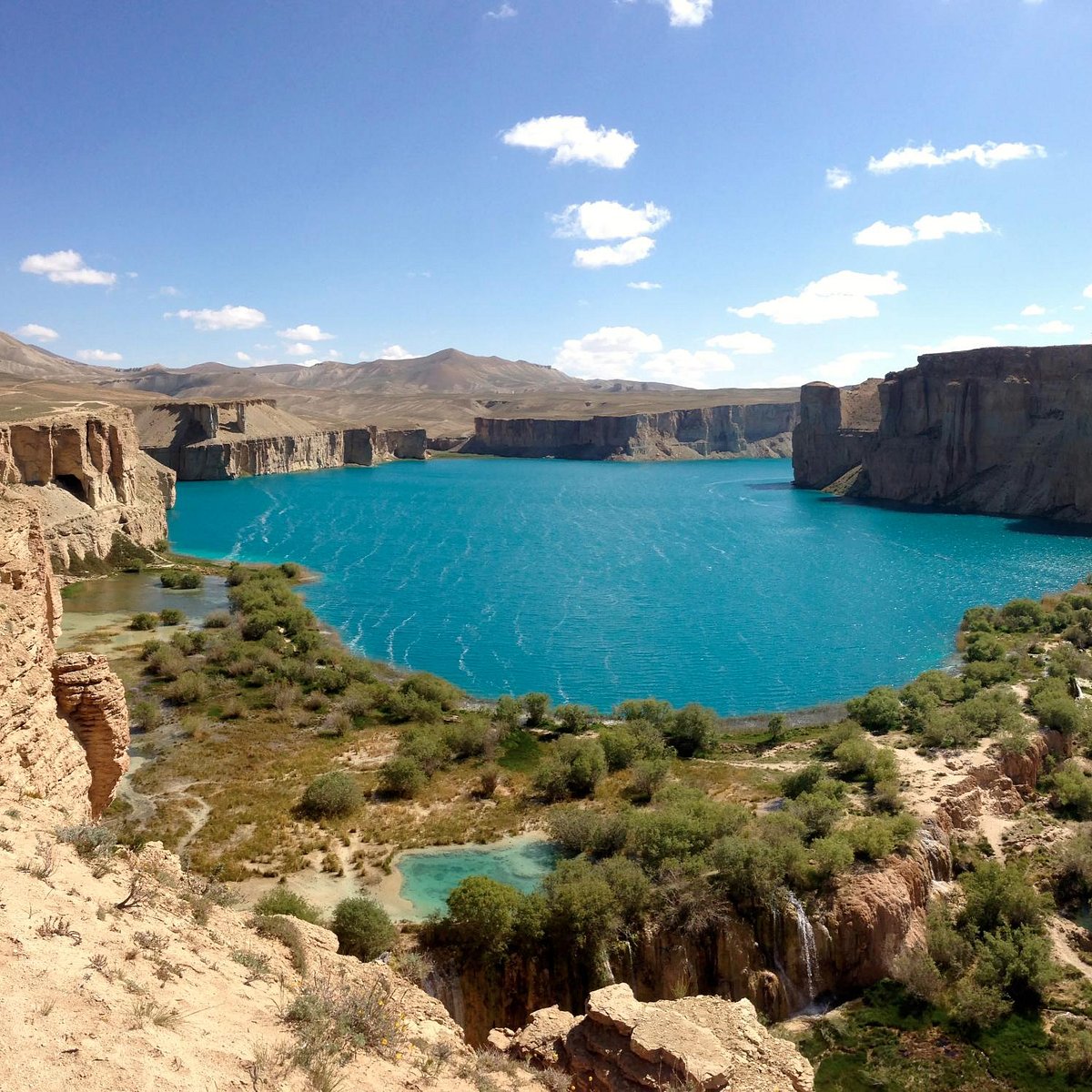
Band-e Amir National Park
The Band-e Amir National Park is one of Afghanistan's most spectacular natural beauties. It was made up of six deep blue lakes that are divided by natural dams formed of natural stone, a mineral deposit.
The Band-e Amir has been nicknamed Afghanistan's Grand Canyon, with its 370 square kilometers of towering cliffs and cascading lakes on the edge of the Hindu Kush Mountains. Thousands of tourists visit Band-E Amir National park to enjoy its beauty every year.
This article will cover all the information you need to know before traveling to Band-e Amir National Park in Afghanistan. We have discussed its history, the lakes you can see at the Band-e Amir site, and how to reach there. Keep reading!
Band-e Amir National Park in Afghanistan: A Brief Overview
Band-e-Amir National Park is the country's first national park, formally proclaimed in 2009, and is home to six lakes known for their unique deep blue color caused by mineral deposits. These fabled blue lakes are located in the hilly Hazarajat at an elevation of around 3000 meters and are about 75 kilometers to the North West from Bamiyan.
Natural travertine layers separate the lakes, making it one of the world's few travertine systems. It is surrounded by the Hindu Kush Mountains and serves as one of Afghanistan's tourism hubs. While the region possesses a richness of natural and agricultural resources, the potential for ecotourism implies that the region's economic reliance on these resources has decreased.
If you are in Afghanistan, don’t miss visiting Band-e Amir National Park and the lakes of this region.
History of Band-e Amir National Park, Afghanistan
Band-e Amir clearly translates as "the Ruler's Dam," and some believe it is a reference to Ali, the fourth Caliph of the Muslims. The area is dominated by ethnic Hazaras, who account for over 40% of Afghanistan's population.
Band-e Amir was nominated for UNESCO World Heritage status in 2004. Efforts to establish Band-e Amir as a national park began in the 1970s but were halted due to the conflicts. It was ultimately designated as Afghanistan's first national park in April 2009, and every year, around thousands of visitors visit the Band-e Amir National Park. A modest number of park rangers patrol the region.
Band-e Amir Lakes
Are you planning a trip to Band-e Amir National Park and looking for what to see at Band-e Amir? Well, this amazing place is famous for the Band e Amir lakes.
Here are the lakes that you can see at Band e Amir in Afghanistan:
1. Band-e Gholaman: Dam of the Slave
This lake is known as the Lake of Slaves and has unfortunately dried up. It is located in the lake region's far west. There are also many gorgeous sceneries that you can capture with your camera.
1. Band-e Qambar: Dam of Caliph Ali’s Slave
In Afghanistan, Qambar refers to as Ali's salve. It is one of the natural park's six lakes. It is situated in the lake region's southwest corner.
2. Band-e Haibat: Dam of the Grandiose
Band-e Haibat will be your first stop as you explore Band-e Amir National Park. The lake's name, 'Dam of the Grandiose,' is undoubtedly derived from the contrast of its blue waters with the orangey-pink Hindu Kush cliffs behind it. As you descend into Band e Amir, you will pass through a tiny town where you may stop for a cup of tea at a chai khana or buy handicrafts, jewelry, and textiles offered by locals.
3. Band-e Panir: Dam of Cheese
This lake is appropriately called for its white-washed coastlines, which resemble paneer or cheese in English. Panir was engaged in the development of the Band-e Amir Lakes in some way (although no one has been able to tell how).
4. Band-e Pudina: Dam of Mint
Band-e Pudina is nestled between Band-e Zulfiqar, Band-e Haibat, and Band-e Panir, beautifully sandwiched and surrounded by wild greens. Band-e Pudina takes its name from the wild mint plant that grows around the lake.
5. Band-e Zulfiqar: Dam of the Sword of Ali
Band-e Zulfiqar is the first lake you'll see as you drive down the sandy road toward Band-e Amir National Park. A stone walkway from the cliffs above down to the shores of Band e Amir's main lake is being built as part of an ongoing project.
As you make your way over to the Tomb and paddleboats, don't miss the Band-e Haibat waterfall, where you can witness the sapphire blues wash over the travertine wall that holds the lake up.
The Tomb of the Amir is a tiny mausoleum located on the lake's beaches. The faithful may be spotted visiting the shrine and soaking in the freezing waters, which are said to have therapeutic effects.
If you are fond of lakes, then you must visit Band-e Amir lakes in the Band-e Amir National Park, and don’t forget to capture all the scenes in your camera and memory.
How to get to Band-e Amir National Park in Afghanistan
While planning a trip to Band-e Amir National Park, Afghanistan, you must first reach Bambyan. So let’s first know how to reach Bambyan.
To reach Bambyan, you can opt for two ways:
· By road: There are two highways from Kabul to Bamyan, the southern route via Wardak Province and through Hajigak Pass being shorter but riskier and is more commonly used by public transportation and indigenous residents of the central highlands.
The northern route begins near Charikar on the road leading north from Kabul. It travels from Charikar to Parwan Province, passing through Ghorband on its way to Shibar Pass. The whole journey duration is around 6 hours. It's less risky.
· By air: Some non-governmental organisations (NGOs) and the military fly for their own objectives. Kam Air operates three commercial flights each week (Saturday, Monday, and Thursday).
Because Bamyan town is tiny, strolling is the best choice. Around the region, you may rent a Toyota Corolla or ask the management of your hotel to locate a vehicle, bike, or horse!
Now, let’s get to the final destination Band-e Amir National Park from Bamyan. The trip from Bamyan Bazaar to Band e Amir will take roughly an hour. The cost of hiring a cab for the day to drive you to the lakes is around 1,500 AFS. It is possible to take a shared cab from the Bamyan Bazaar to Band-e Amir for 250 AFS each trip.
When entering the National Park, a 200 AFS entry fee must be paid in cash at the gate.Night Stay: Accommodation in Band-e Amir National Park
You have several options if you want to spend the night at Band-e Amir National Park. There will be hotels in the park where you may stay.
· Qal’ej Far: This lodging option is located south of the park. In this place, you may get lodging. We do, however, recommend that you phone this location first.
· Camping at Band-e Amir: If you want to camp out in this magnificent environment, there is a camping spot located north of the lake region. Park officials guard the camping area. This will be a thrilling and risk-free experience for you.
Conclusion
Band-e Amir is a UNESCO World Heritage site of Afghanistan and a beautiful national park surrounded by six lakes, as you go through in this article. Band-e Amir National Park is a well-known foreign and domestic tourism destination in Afghanistan. It is close to the cities of Bamyan, Panjab, and Behsud in Pakistan. There are some nice spots to visit in the natural park. It is well-known for its gorgeous vistas and is an excellent spot for photography. The national park also has various lodging options.
Former Afghan authorities worked hard to turn this area into a national park. However, Afghanistan established it as a national park in 2009. During Afghanistan's civil war, the park was not affected. If you want to visit Bamiyan, this is one of the places you should go.
00 Comments
No comments yet.
Leave a Comment