

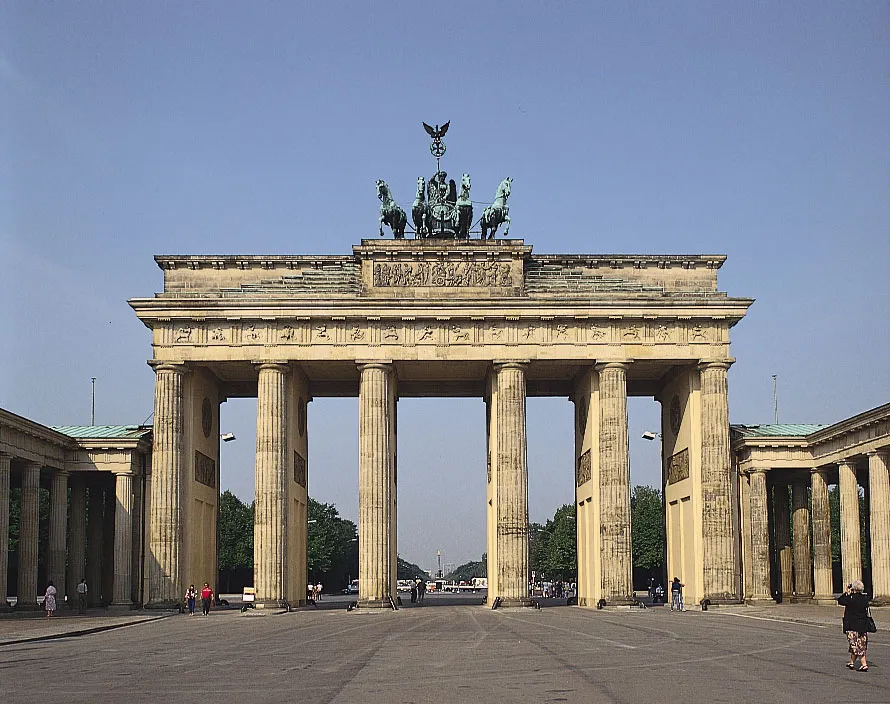
Brandenburg Gate
The Brandenburg Gate is one of Berlin's most famous places, a landmark, and an emblem with a history that spans over two centuries. The enormous sandstone gate in the middle of the city is present on every tourist's itinerary. The Brandenburg Gate was once a memorial of separation. After the Berlin Wall was built, it was situated in a restricted area and could not be visited by East or West Germans. The gate became a symbol of German togetherness when the Wall fell.
The Brandenburg Gate has become emblematic of Germany due to the great events that it has seen. Napoleon walked across it, and more recently, it split East and West Germany. Today, it is a popular tourist destination not just because of its historical value, but also due to its location.
Stay connected to get more detailed information on the Brandenburg Gate in Berlin before paying a visit to the place.
Importance of Brandenburg Gate
The Brandenburg Gate is an important symbol of German history and unity. The gate is located in Berlin, Germany, and was built in the 18th century. It is made of cast iron and stone and is 26 meters high. The Brandenburg Gate has been the site of many important historical events, such as the fall of the Berlin Wall, and is a popular tourist destination.
It has come to symbolize the division between East and West and the reunification of Germany. The Gate is also a powerful symbol of freedom and democracy.
The Brandenburg Gate is on Pariser Platz, one of Berlin's most scenic squares, in the center of the city. The lovely Unter den Linden Street leads directly to the plaza, which is bordered by noteworthy structures such as the Adlon Kempinski, the University of the Arts, the US Embassy, Berlin State Opera, Crown Prince's Palace, St. Hedwig's Cathedral, and the Historical Museum. The nearby cafés and eateries urge people to stay and experience the distinctive atmosphere.
For these reasons, the Brandenburg Gate is an important site for both Germans and visitors to Germany. It is a place of both historical and national significance. When visiting the Gate, be sure to take some time to appreciate its history and meaning.
History of Brandenburg Gate
King Frederick William II commissioned the huge sandstone Brandenburg Gate as a dignified finish to the great street Unter den Linden, Berlin. It was built between 1788 and 1791 and was Berlin's first Greek revival structure. Carl Gotthard Langhans, the architect who created it, took the inspiration from the impressive gateway that leads to the Acropolis in Athens. The Brandenburg Gate is supported by two rows of six Doric columns and is 26 meters high, 11 meters deep, and 65.5 meters long.
Quadriga Figure
The Quadriga figure, created by Johann Gottfried Schadow, was set above the gate in 1793. This statue, too, has a backstory. When Napoleon's armies took Berlin in 1806, he had the Quadriga transported to Paris as war treasure and a symbol of his victory. Following Napoleon's forced resignation in 1814, the Quadriga was returned to Berlin and re-erected atop the Brandenburg Gate, facing east towards the city center.
Originally, the Quadriga on top of the Gate, driven by Nike, the Greek Goddess of Victory, was supposed to represent Peace. Unfortunately, things had to alter around the turn of the nineteenth century.
The Iron Cross, designed by the renowned Berlin architect Schinkel and put within a laurel wreath in 1814, would go on to become one of the most famous Prussian and German military medals. Truth is that it was constructed to honor the soldiers for their struggles for freedom, particularly those who fought against Napoleon after he conquered Berlin with the French army in 1806.
After Napoleon's defeat, the Peace Gate was renamed the Brandenburg Gate. The Brandenburg Gate was in the Soviet sector following the postwar partition of Germany and Berlin in 1946. When the Berlin Wall was built in 1961, the Gate was located in an exclusion zone in an arc of the wall, making it inaccessible to both residents and tourists.
The Brandenburg Gate surrounds Pariser Platz, one of the city's most beautiful squares. The structures around this ancient area were in ruins after WWII. After German reunification in the 1990s, reconstruction at this great site began, and the buildings now feature magnificent town residences, embassies, and the stunning five-star hotel Adlon.
Historical persons involved in the Brandenburg Gate
Napoleon: Following his conquest of Berlin in 1806, he brought the Quadriga (placed at the top of the Brandenburg Gate) to France, intending to mount it atop the Arc de Triomphe in Paris.
Adolf Hitler: He used the Gate to symbolize his dominance. Under its arcades, many Germans marched towards tragedy, swayed by their Führer's power and magnetism.
Ronald Reagan: The Door served as the backdrop for his iconic address in Berlin in 1987.
The Best Way to get to the Brandenburg Gate in Berlin
The Brandenburg Gate is one of the most iconic landmarks in Berlin, and it's also one of the most popular tourist destinations in the city. If you're planning a trip to Berlin, you'll probably want to visit the Brandenburg Gate at some point. But what's the best way to get there?
There are a few different ways to get to the Brandenburg Gate:
· By metro: Brandenburger Tor station (lines U55, S1, S2);
· By bus: Brandenburger Tor stop (Bus line 100);
Entry Fee: no entrance fee
Conclusion
The Brandenburg Gate is a timeless masterpiece that has stood in the heart of Berlin for centuries. A symbol of German history and culture, the Brandenburg Gate is a must-see for anyone visiting the city. Although it has undergone many changes over the years, the Brandenburg Gate remains an iconic symbol of Berlin and a reminder of the city's rich history.
00 Comments
No comments yet.
Leave a Comment