

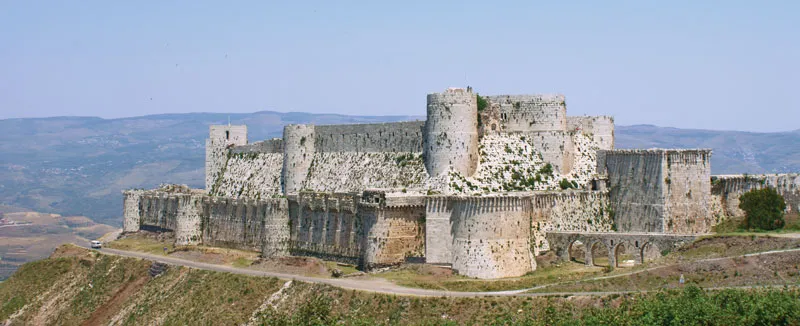
Krak Des Chevaliers Castle
In Syria, a nation with a rich history and culture there lies a marvel of architecture called the Krak des Chevaliers Castle. This castle, which is regarded as one of the most spectacular strongholds in the world, played a key part in Middle Eastern history.
The Krak des Chevaliers (Qal'at al-Hosn), is one of the best examples of military architecture from the 12th to 13th centuries. It is the most significant Crusader fortress erected in the Near East, both in terms of quality of construction and outstanding condition of conservation.
The Krak des Chevaliers Castle will be briefly discussed in this article, along with its history, significant characteristics, and current significance. Don't miss visiting Krak des Chevaliers Castle during your trip to Syria.
Krak des Chevaliers Castle, Syria: A Brief Introduction
A castle in Syria called Krak des Chevaliers is also known in Arabic as Hisn al-Akrad. It was initially constructed by the Emir of Aleppo. In 1144 CE, the Knights Hospitaller captured the fortress and completely rebuilt it. It was the biggest Crusader stronghold in the Middle East and a bastion against the growth of the Muslim nations in the 12th and 13th centuries CE.
Krak des Chevalier is a historic fortress in Syria. The castle is undoubtedly the most impressive Crusader-era structure. It is often regarded as the most beautiful of all crusader castles. Its unmatched craftsmanship speaks of the same commitment to faultless accuracy and architectural brilliance seen in the huge Gothic cathedrals that were being built in Western Europe at the same time. It is carved from limestone and has an exquisite elegance of proportion. Nowadays, the castle is recognized by UNESCO as a World Heritage site.
Krak des Chevaliers Castle: History
Krak des Chevaliers was the eastern side of five Crusader fortresses controlling the sole significant pass (known as the 'Homs Gap' in the Orontes River Valley) connecting Antakya, Turkey, and Beirut, Lebanon. The Order of the Knights of St John constructed and extended the fortress at Qal'at al-Hisn between 1142 and 1271. It measures 3 hectares in area and could accommodate a force of up to 2000 men at its peak. The stronghold stood up against multiple violent attacks (including one by the renowned Saladin) and was thought to be invincible. Krak des Chevaliers was one of the most significant, serving as both an administrative headquarters and a military base.
Krak des Chevaliers Castle: Features
The castle at Krak des Chevaliers is a magnificent illustration of medieval engineering and architecture. The castle has a number of defense features that were innovative for their day, and it was built to survive assaults and sieges. The walls of the castle are over 30 meters tall and fortified with numerous towers and turrets. Because it combines aspects of Islamic and Crusader architectural styles, the castle's architecture and design are distinctive.
The layout and construction of the Krak des Chevaliers Castle are among its most striking aspects. There are various sections of the castle, each with a distinct function. The greatest area of the castle, the Grand Courtyard, is enclosed by walls and towers. Another important feature of the castle is the Great Hall, which served as the location of meetings and banquets for the Knights Hospitaller.
Inside the castle is the stunning chapel, a place of worship that features elaborate carvings and decorations. The Keep, which is located at the highest point of the castle, offers a magnificent view of the surroundings.
Major Attractions of the Castle
The architect of Castle
The architect of the castle is made of two concentric enceintes that are 300 meters long and 140 meters broad make up the remaining castle. A polygonal enceinte dotted with turrets of various designs encircles the upper ward. Round and horseshoe-shaped towers appear from a massive talus to the south and west. The bedrock serves as a natural foundation for the chapel and adjacent curtain walls on the north and northeast facades. A second enceinte constructed on a lower ward surrounds this main defensive barrier. Moreover, this enceinte is peppered with towers in a variety of designs, which indicate successive stages of building and renovation.
The great Gothic Hall
A large hall was constructed inside the top castle, adjacent to the church, during the middle of the 13th century, during the Krak des Chevalier's final construction phase. The hall resembles the substantial seigneurial halls typical in West European castles, but it also has a monastery chapter house feel to it in the Krak des Chevaliers. The councils, the chapter, and the parties were held here. The spacious hall, which is 27 meters long and 7.5 meters broad, was first split in half by a wall that had three oculi and a door. It has three bays with ribbed vaults sitting on cul-de-sacs embellished with crockets and plant life.
In the Rayonnant Gothic style of the Île-de-France area, it is preceded to the east by a portico resembling a cloister gallery and enters the courtyard through two portals and five twin bays split by elegant columns. The corbels supporting the ogives, double arches, and rib arches are adorned with floral designs reminiscent of those seen on the Sainte-Chapelle in Paris.
The Best Way to Get to Krak des Chevaliers Castle
Location: The castle is located in the Homs Gap, east of Tripoli, Lebanon, on top of a 650-meter-high hill along the sole path from Antioch to Beirut and the Mediterranean Sea. It is located 90 miles northwest of Damascus and around 40 kilometers west of Homs, near the border with Lebanon, and is administratively part of Syria's Homs Governorate.
By Bus: Krak des Chevaliers is a simple journey by bus from Homs and drop off guests at the castle. The journey takes less than an hour each way. Bus tickets cost less than approximately $1.
By Cab: Depending on your bargaining abilities, a cab from Damascus will cost roughly US$ 60 round trip, with the driver waiting outside. Several Damascus hotels provide bus rides to the castle; however, it makes for a very lengthy day out for only one attraction.
Timings: Open Sunday through Friday
April to October: 09:00 am – 06:00 pm
November to March: 09:00 am – 04:00 pm
Entry Fee: Adults $3
Conclusion
The Krak des Chevaliers Castle is a work of art and a tribute to the creativity and talent of its architects. Anyone interested in history or architecture must visit the castle because of its fascinating past and distinctive fusion of architectural styles. It is impossible to overestimate the castle's significance for Syria's cultural legacy, and the fact that it has been designated a UNESCO World Heritage Site speaks to its relevance on a larger scale. The Krak des Chevaliers Castle offers visitors the chance to travel back in time and see the intriguing world of medieval Syria.
00 Comments
No comments yet.
Leave a Comment