

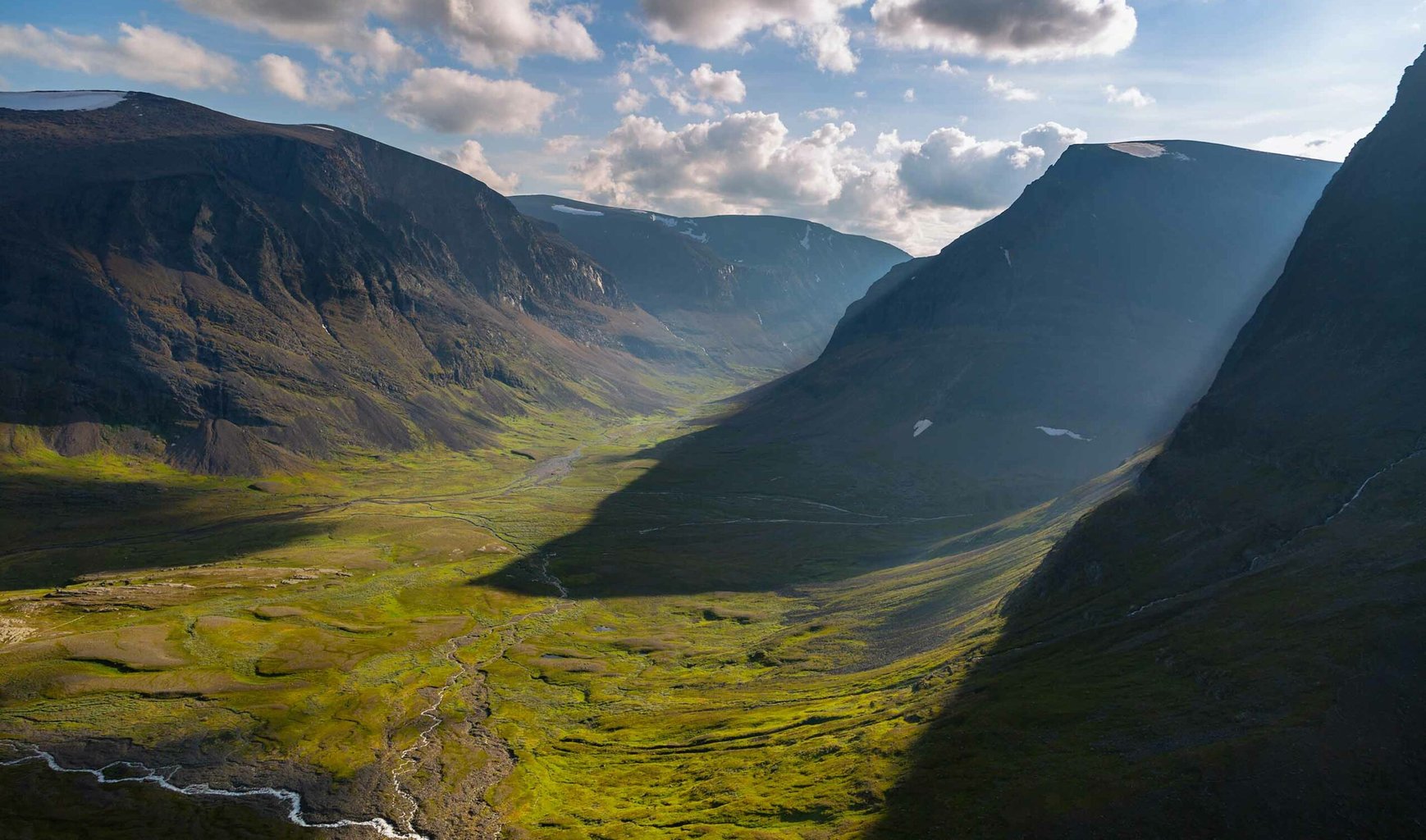
Kungsleden
Introduction
Stretching through the remote mountains of Swedish Lapland, Kungsleden, meaning "The King's Trail," is one of Europe's most remarkable long-distance hiking routes. Running between Abisko in the north and Hemavan in the south, the trail covers roughly 450 kilometers and passes through some of Sweden's most spectacular mountain landscapes.
Kungsleden is much more than a hiking trail. It is a journey through vast Arctic valleys, mountain plateaus, birch forests, crystal-clear lakes, rushing rivers, glaciers, and remote wilderness. Along the route, hikers experience dramatic changes in scenery, from the alpine landscapes surrounding Abisko and Kebnekaise to the broad mountain valleys and forests farther south.
The trail also passes through four national parks - Abisko, Stora Sjöfallet, Sarek, and Pieljekaise - as well as the UNESCO World Heritage Site of Laponia, making it one of the most rewarding hiking routes for travelers interested in both nature and culture.
Whether you hike a short section or attempt the entire route, Kungsleden offers a rare opportunity to experience the vastness of Scandinavian wilderness.
For travelers searching for unique places to visit in Sweden, this Kungsleden travel guide explores its landscapes, hiking routes, wildlife, Sámi heritage, best time to visit, transportation, sustainability, and why the King's Trail deserves a place on every serious adventure travel itinerary.
Where Is Kungsleden? Geography and Arctic Landscape
Kungsleden crosses the mountainous region of Swedish Lapland, far north of the Arctic Circle.
The traditional route stretches between:
- Abisko in the north
- Hemavan in the south
The complete trail is around 450 kilometers long and is divided into several major sections, allowing travelers to experience it in stages rather than completing the entire route in one expedition.
The landscape changes constantly.
Hikers can encounter:
- Alpine mountains
- Mountain birch forests
- Vast valleys
- Glacial landscapes
- Rivers
- Lakes
- Wetlands
- Rocky plateaus
- Arctic tundra
- Snow-covered peaks
This diversity is one of Kungsleden's greatest attractions.
Why Is Kungsleden Famous?
Kungsleden is famous for combining accessibility with an extraordinary sense of wilderness.
The trail is known for:
- Long-distance hiking
- Arctic landscapes
- Swedish Lapland
- Mountain cabins
- Abisko National Park
- Sarek National Park
- Laponia
- Sámi culture
- Midnight Sun
- Autumn colors
- Wildlife
- Remote mountain scenery
The trail was established by the Swedish Tourist Association (STF) in the early 20th century with the goal of making the Swedish mountains more accessible while showcasing their most beautiful landscapes.
More than a century later, Kungsleden has become one of the world's best-known hiking routes.
Abisko - The Northern Gateway to Kungsleden
For many travelers, Abisko is the natural starting point for exploring Kungsleden.
The nearby Abisko National Park contains a spectacular mountain landscape of birch forests, open alpine terrain, flowering meadows, rivers, and rugged peaks.
The Kungsleden follows the Abiskojåkka River through the park before reaching the impressive Abisko Canyon and the shores of Torneträsk, one of the largest mountain lakes in Scandinavia.
Abisko is also particularly famous for its clear mountain air and long summer daylight.
During the summer season, the Midnight Sun allows hikers to experience daylight around the clock.
Lapporten - Sweden's Iconic Mountain Gateway
One of the most recognizable landscapes near the northern section of Kungsleden is Lapporten, or "Lapland's Gate."
The distinctive U-shaped mountain valley has become one of Swedish Lapland's most famous natural symbols.
The surrounding mountains create a dramatic gateway into the Arctic landscape.
For photographers, Lapporten is particularly impressive when viewed under changing northern light, with clouds, snow, or the warm colors of the setting sun adding different moods to the landscape.
Kebnekaise and Sweden's High Mountains
The northern section of Kungsleden passes close to the dramatic mountain world surrounding Kebnekaise, Sweden's highest mountain.
Although the main Kungsleden does not simply lead directly over the summit, hikers can use connecting routes to explore the Kebnekaise mountain area.
This region provides some of Sweden's most spectacular alpine scenery, including:
- High mountain peaks
- Glacial valleys
- Rocky ridges
- Snowfields
- Mountain lakes
The landscape becomes increasingly dramatic as hikers move through the high mountain areas of northern Lapland.
Kungsleden Through Four National Parks
One of Kungsleden's greatest strengths is the number of protected landscapes it connects.
The route passes through four Swedish national parks:
- Abisko National Park
- Stora Sjöfallet National Park
- Sarek National Park
- Pieljekaise National Park
These parks protect some of Sweden's most valuable mountain and wilderness environments.
The trail therefore provides an extraordinary opportunity to experience several different ecosystems during one long-distance adventure.
Sarek National Park - Sweden's Wild Heart
The Kungsleden passes through the southern part of Sarek National Park, one of Europe's most rugged wilderness areas.
Sarek is famous for:
- High mountains
- Glaciers
- Deep valleys
- Wild rivers
- Remote wilderness
- Limited infrastructure
Unlike some other parts of Kungsleden, Sarek can feel considerably more remote.
The landscape is particularly attractive to experienced hikers who want to explore one of Europe's least developed mountain environments.
The Mountain Cabins of Kungsleden
One of the features that makes Kungsleden particularly attractive is its network of mountain cabins.
The Swedish Tourist Association operates 16 mountain cabins along the King's Trail, providing hikers with opportunities to stay overnight during parts of the journey.
These cabins provide a simple alternative to carrying a full camping setup throughout the entire hike.
Depending on the location, facilities can include:
- Sleeping areas
- Cooking facilities
- Wood-burning stoves
- Basic supplies
- Water access
- Mountain hosts during parts of the season
The experience is deliberately simple, allowing travelers to remain immersed in the wilderness.
Hiking Kungsleden
One of the best things about Kungsleden is that you do not have to hike all 450 kilometers to experience it.
Travelers can choose individual sections based on:
- Fitness
- Available time
- Weather
- Hiking experience
- Interests
- Transportation
The northern section between Abisko and Nikkaluokta is particularly popular and typically takes around a week when combined with the relevant routes.
Long-distance hikers can undertake larger sections or attempt the complete Abisko-to-Hemavan journey.
This flexibility makes Kungsleden suitable for both experienced trekkers and travelers attempting their first major multi-day Scandinavian hike.
The Southern Kungsleden
The southern section around Hemavan and Ammarnäs offers a different landscape from the dramatic alpine scenery farther north.
Here, hikers encounter:
- Wide mountain valleys
- Mountain birch forests
- Lakes
- Wetlands
- Open plateaus
- Dramatic peaks
The Syterskalet valley is one of the highlights of this section.
The route also passes Norra Sytertoppen, which reaches approximately 1,768 meters above sea level, the highest peak in Västerbotten County.
Another memorable feature is the group of seven bridges crossing the southern part of Lake Tärnasjön.
Wildlife Along Kungsleden
Kungsleden passes through some of northern Sweden's most important wildlife habitats.
Travelers may encounter:
- Reindeer
- Moose
- Arctic foxes
- Brown bears
- Lynx
- Wolverines
- Golden eagles
- Ptarmigans
- Mountain birds
- Migratory species
Most large predators are extremely elusive, meaning sightings are uncommon.
Reindeer, however, are much more closely associated with the landscape and can sometimes be seen moving across the mountains.
Wildlife should always be observed from a respectful distance.
Sámi Culture and the Landscape
Kungsleden passes through Sápmi, the traditional cultural region of the Sámi people.
The Sámi have lived across northern Scandinavia for centuries, with traditions closely connected to reindeer herding, seasonal movement, nature, crafts, food, and storytelling.
The landscape surrounding Kungsleden is therefore not simply "empty wilderness."
It is also a living cultural landscape.
Travelers should respect local traditions, reindeer herding activities, private areas, and seasonal restrictions while hiking.
Experiencing Kungsleden with an understanding of Sámi heritage adds a deeper cultural dimension to the journey.
Swedish Lapland in Summer
Summer is one of the most extraordinary times to hike Kungsleden.
From late spring into summer, northern Sweden experiences extremely long daylight hours.
In the far north, the Midnight Sun means the sun remains above the horizon for extended periods.
This creates almost unlimited daylight for hiking and photography.
Summer landscapes feature:
- Green mountain valleys
- Blooming alpine flowers
- Flowing rivers
- Snow remaining on high peaks
- Clear mountain lakes
- Golden evening light
The extended daylight is one of the defining experiences of hiking in Arctic Sweden.
Autumn on Kungsleden
Autumn transforms the mountains into a spectacular palette of gold, orange, red, and deep green.
The mountain birch forests are especially beautiful during this period.
This seasonal phenomenon is commonly called ruska in northern Scandinavia.
For photographers, autumn can be one of the best times to explore Kungsleden because the combination of colorful vegetation, clear mountain air, and snow-dusted peaks creates extraordinary scenery.
However, temperatures drop quickly, and weather conditions become more unpredictable.
Winter and Kungsleden
Kungsleden is primarily associated with summer and autumn hiking, but parts of the route can also be experienced during winter through specialized winter travel.
Snow transforms the landscape into a vast Arctic wilderness.
Winter activities may include:
- Ski touring
- Cross-country skiing
- Snowshoeing
- Winter camping
- Dog sledding in nearby areas
- Northern Lights photography
Winter travel requires significantly more preparation than summer hiking because of extreme cold, snow, limited daylight, and changing mountain conditions.
Best Things to Do Along Kungsleden
Kungsleden offers far more than simply walking from one point to another.
Popular experiences include:
- Long-distance hiking
- Mountain photography
- Wildlife watching
- Camping
- Staying in mountain cabins
- Fishing where permitted
- Landscape photography
- Ski touring
- Exploring national parks
- Experiencing the Midnight Sun
- Autumn photography
- Learning about Sámi culture
The journey itself becomes the destination.
Swedish Food Along the Trail
Food is an important part of any multi-day Kungsleden adventure.
Hikers commonly carry lightweight foods such as:
- Oatmeal
- Pasta
- Rice
- Dried vegetables
- Bread
- Cheese
- Chocolate
- Nuts
- Dried berries
- Instant meals
Some STF mountain huts also sell food supplies, although prices are generally higher than in supermarkets, so hikers usually carry at least part of their provisions.
In the wider region, travelers can experience traditional northern Swedish ingredients such as:
- Reindeer
- Arctic char
- Salmon
- Cloudberries
- Lingonberries
- Wild mushrooms
- Potatoes
- Rye bread
Sustainable Tourism on Kungsleden
Kungsleden passes through fragile Arctic ecosystems where vegetation can take a long time to recover from damage.
Responsible hiking is therefore essential.
Visitors should:
- Stay on marked trails
- Carry all rubbish
- Respect wildlife
- Avoid disturbing reindeer
- Follow camping regulations
- Use established facilities
- Respect national park rules
- Minimize fires
- Avoid damaging vegetation
Sweden's national parks have specific regulations designed to protect sensitive landscapes, and these rules can vary between parks.
One simple principle is especially important: leave the wilderness as you found it.
Best Time to Hike Kungsleden
The best time for a traditional Kungsleden hiking adventure is generally July through early September.
June
Snow may remain at higher elevations, but long daylight hours make this an exciting time for experienced hikers.
July and August
These are the main hiking months, with relatively accessible trails, long daylight, and open mountain facilities.
September
Autumn colors can be spectacular, while crowds begin to decrease.
October to May
Winter conditions dominate the mountains. Hiking becomes much more demanding and is better suited to experienced winter travelers.
Always check current trail, weather, cabin, and transportation conditions before beginning a trip.
How to Get to Kungsleden
The northern gateway of Abisko is particularly accessible.
Travelers can reach Abisko by train from southern Sweden, including overnight services from Stockholm, or via connections through Kiruna.
Other access points include:
- Nikkaluokta
- Saltoluokta
- Kvikkjokk
- Ammarnäs
- Hemavan
This network of access points makes it possible to design a Kungsleden itinerary around a particular section rather than completing the entire route.
Because mobile coverage can be unreliable in the Swedish mountains, hikers should carry offline maps and appropriate navigation equipment. The Norrbotten outdoor map service specifically warns that mobile coverage is very common to lack in the mountains and recommends offline navigation and extra power capacity.
Essential Travel Tips for Kungsleden
A successful Kungsleden adventure requires preparation.
- Wear waterproof hiking boots.
- Carry waterproof and windproof clothing.
- Bring warm layers even in summer.
- Pack enough food for remote sections.
- Carry a physical or offline map.
- Bring a power bank or backup charging solution.
- Check weather forecasts daily.
- Understand river-crossing conditions.
- Tell someone your planned route.
- Respect mountain cabin rules.
- Prepare for mosquitoes during summer.
- Never underestimate Arctic weather.
The mountains can change dramatically within hours.
Good preparation allows hikers to enjoy the wilderness without taking unnecessary risks.
Why Visit Kungsleden?
Kungsleden is one of Europe's rare hiking routes where the feeling of true wilderness remains central to the experience.
You can walk for hours through enormous valleys without encountering roads, cities, or large settlements.
One day may involve alpine peaks and glaciers, while the next leads through silent birch forests beside a turquoise river.
The combination of nature, culture, remoteness, and accessibility makes Kungsleden exceptional.
For adventure travelers, it offers a serious long-distance challenge. For photographers, it provides some of Sweden's most spectacular landscapes. For nature lovers, it provides an opportunity to experience Arctic ecosystems at close range.
And for anyone who wants to escape crowded tourist destinations, Kungsleden offers something increasingly valuable - space.
Conclusion
Kungsleden is far more than a hiking trail - it is a journey through the heart of Swedish Lapland.
From the mountain valleys of Abisko and the dramatic landscapes near Kebnekaise to the remote wilderness of Sarek and the broad valleys around Hemavan, the route reveals the extraordinary diversity of northern Sweden. Its approximately 450 kilometers connect national parks, mountain landscapes, rivers, forests, lakes, and cultural landscapes into one unforgettable adventure.
Whether you hike a short section, spend a week exploring the northern mountains, or attempt the full Abisko-to-Hemavan journey, Kungsleden offers an experience that combines adventure with profound natural beauty.
For travelers searching for unique places to visit in Sweden, spectacular hiking trails, Arctic wilderness, Sámi culture, mountain landscapes, and unforgettable outdoor experiences, Kungsleden truly deserves its reputation as Europe's Ultimate Arctic Hiking Trail.
00 Comments
No comments yet.
Leave a Comment