

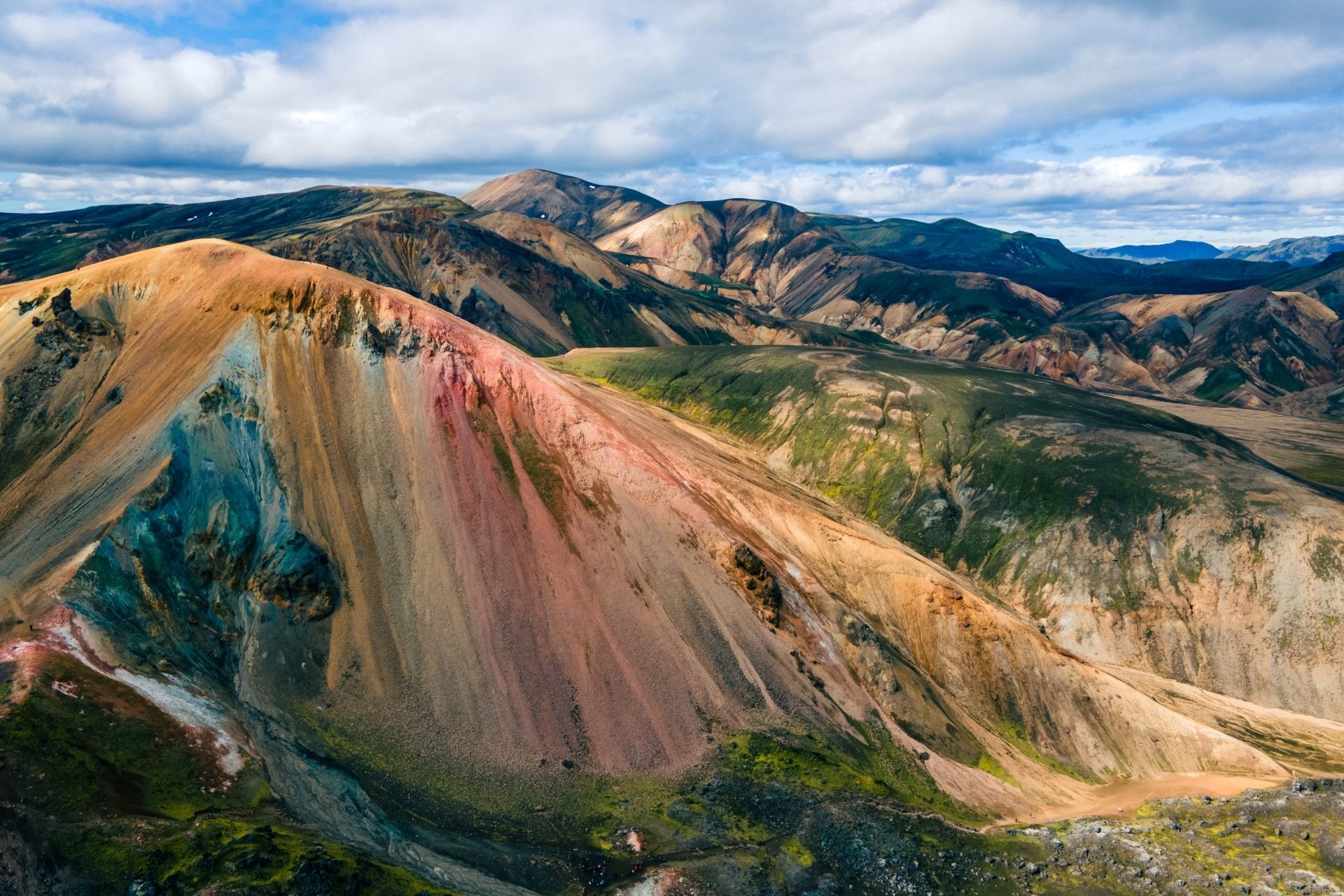
Landmannalaugar
Introduction
Deep within the rugged interior of Iceland lies Landmannalaugar, a spectacular highland region famous for its colorful mountains, steaming geothermal springs, black lava fields, deep valleys, and dramatic volcanic landscapes. Often described as Iceland's Rainbow Mountain Wilderness, Landmannalaugar is one of the country's most extraordinary destinations for hikers, photographers, and adventure travelers.
Located within the Fjallabak Nature Reserve, Landmannalaugar sits in a remote volcanic region where powerful geological forces have shaped the landscape for thousands of years. The mountains display unusual shades of red, orange, yellow, green, brown, and purple, created by volcanic minerals and rhyolite rock.
The scenery becomes even more dramatic when colorful mountains are contrasted with black obsidian lava fields and brilliant green moss. Geothermal activity adds another layer to the landscape, with steam rising from the ground and naturally heated pools providing an unforgettable place to relax after a long hike.
Landmannalaugar is also the starting point of the famous Laugavegur Trail, one of Iceland's most celebrated hiking routes.
For travelers looking beyond Iceland's famous waterfalls and glaciers, this Landmannalaugar travel guide explores the geography, volcanic history, hiking trails, geothermal features, wildlife, best time to visit, transportation, sustainability, and unforgettable experiences of one of Iceland's most beautiful highland destinations.
Where Is Landmannalaugar? Geography and Volcanic Landscape
Landmannalaugar is located in the southern Icelandic Highlands, approximately 180 kilometers east of Reykjavík by road, although travel time can be considerably longer because of mountain roads and conditions.
The region forms part of the Fjallabak Nature Reserve, an enormous protected landscape characterized by volcanic mountains, lava fields, rivers, hot springs, and valleys.
Landmannalaugar is particularly famous for its rhyolite mountains.
Rhyolite is a volcanic rock rich in minerals that can produce remarkable colors. Depending on the light and geological composition, the mountains can appear:
- Orange
- Red
- Yellow
- Green
- Pink
- Purple
- Brown
- Gray
The surrounding black lava fields provide a dramatic contrast, creating one of the most recognizable landscapes in Iceland.
Why Is Landmannalaugar Famous?
Landmannalaugar is famous for its extraordinary combination of colorful mountains and geothermal activity.
The region is known for:
- Rainbow-colored rhyolite mountains
- Natural hot springs
- Black lava fields
- Volcanic valleys
- Laugavegur hiking trail
- Fjallabak Nature Reserve
- Geothermal landscapes
- Highland photography
- Midnight Sun
- Dramatic Icelandic wilderness
Unlike many Icelandic attractions that can be visited in a few hours, Landmannalaugar rewards travelers who slow down and explore its hiking trails.
The Volcanic History of Landmannalaugar
The landscape around Landmannalaugar was created by intense volcanic activity.
The region lies within one of Iceland's most active volcanic zones, where tectonic plates pull apart and magma rises toward the surface.
One of the most important geological features nearby is the Hekla volcanic region, while the Laugahraun lava field forms part of Landmannalaugar's distinctive scenery.
The black lava landscape was produced by relatively recent volcanic eruptions, while older rhyolite formations create the colorful mountains.
This combination of ancient volcanic rock, newer lava, geothermal activity, and glacial forces has created an incredibly diverse landscape within a relatively small area.
Laugahraun - The Black Lava Field
One of the first landscapes many visitors encounter at Landmannalaugar is Laugahraun, a vast field of dark volcanic rock.
The jagged black lava creates a powerful contrast with the colorful mountains surrounding it.
Hiking through this terrain feels almost otherworldly, with twisted lava formations, moss-covered rocks, and distant peaks forming a dramatic volcanic panorama.
The lava field also provides access to several of Landmannalaugar's most popular hiking routes.
Brennisteinsalda - The Rainbow Mountain
Brennisteinsalda is perhaps the most famous mountain in Landmannalaugar.
Its name is often translated as "Sulphur Wave", reflecting the vivid mineral colors covering its slopes.
The mountain displays spectacular shades of:
- Red
- Orange
- Yellow
- Green
- Black
Steam vents and mineral deposits contribute to the mountain's unusual appearance.
A hiking route leads toward Brennisteinsalda and provides panoramic views over lava fields, valleys, and surrounding highlands.
For photographers, it is one of the most rewarding viewpoints in the region.
Bláhnúkur - The Blue Peak
Another iconic mountain is Bláhnúkur, sometimes called the Blue Peak because of its dark blue-gray volcanic appearance.
The mountain rises dramatically above the surrounding valley and provides one of the best panoramic viewpoints near Landmannalaugar.
The hike to its summit is steep in places but offers spectacular views across the colorful rhyolite mountains.
On clear days, the contrast between Bláhnúkur, Brennisteinsalda, and the surrounding lava fields is extraordinary.
Landmannalaugar Hot Springs
One of the most enjoyable experiences in Landmannalaugar is soaking in its naturally heated geothermal pool.
Warm water flows through the landscape, creating a natural bathing area surrounded by mountains.
After hiking through Iceland's cool and unpredictable highland weather, relaxing in the geothermal water can be an unforgettable experience.
Visitors should follow local guidance regarding bathing conditions and avoid areas where geothermal activity makes the water unsafe.
Laugavegur Trail - Iceland's Legendary Hiking Route
Landmannalaugar is the northern starting point of the famous Laugavegur Trail, one of the world's great long-distance hiking routes.
The trail connects Landmannalaugar with Þórsmörk, passing through some of Iceland's most spectacular highland scenery.
Along the route, hikers encounter:
- Colorful mountains
- Black deserts
- Glaciers
- Lava fields
- Geothermal valleys
- Rivers
- Moss-covered landscapes
- Snow-covered peaks
The full trek generally takes several days, making it ideal for experienced hikers looking for an immersive Icelandic wilderness experience.
Best Things to Do in Landmannalaugar
Landmannalaugar offers a wide variety of outdoor experiences.
Popular activities include:
- Hiking
- Landscape photography
- Geothermal bathing
- Mountain trekking
- Exploring lava fields
- Scenic drives
- Birdwatching
- Camping
- Multi-day trekking
- Experiencing the Midnight Sun
Even a short visit can provide spectacular views, but spending several days allows travelers to explore deeper into the highlands.
Wildlife and Natural Environment
Landmannalaugar is not primarily known for large wildlife, but its protected highland environment supports a variety of Arctic and sub-Arctic species.
Visitors may encounter:
- Arctic foxes
- Reindeer in parts of Iceland's eastern highlands
- Rock ptarmigans
- Golden plovers
- Arctic skuas
- Snow buntings
- Various migratory birds
The vegetation is especially interesting.
Despite the harsh climate, mosses, grasses, lichens, and hardy flowering plants survive in sheltered valleys and geothermal areas.
The vivid green vegetation creates a striking contrast with the surrounding volcanic rocks.
Local Culture and Icelandic Highland Heritage
The Icelandic Highlands have historically been associated with seasonal travel, sheep grazing, farming communities, and traditional routes connecting different parts of the country.
For centuries, Icelanders crossed difficult highland terrain on horseback and on foot.
Landmannalaugar's remote location helped preserve its wild character, while modern tourism has introduced hiking huts, marked trails, and limited infrastructure.
The region remains an important part of Iceland's outdoor culture and is closely associated with hiking, trekking, and wilderness exploration.
Icelandic Cuisine After a Highland Adventure
A trip to Landmannalaugar is usually combined with exploring other parts of southern Iceland, where visitors can experience traditional Icelandic cuisine.
Popular foods include:
- Icelandic lamb
- Fresh seafood
- Arctic char
- Rye bread
- Skyr
- Potatoes
- Icelandic soups
- Smoked fish
- Local pastries
A bowl of warm Icelandic soup after a cold day of hiking is particularly satisfying.
Skyr, Iceland's famous cultured dairy product, is also a popular high-protein snack for hikers.
Sustainable Tourism and Conservation
Landmannalaugar is an environmentally sensitive destination.
Its vegetation grows slowly because of the harsh climate, and damage to moss-covered landscapes can remain visible for many years.
Visitors should:
- Stay on marked trails
- Never drive off designated roads
- Avoid stepping on fragile moss
- Take all rubbish with them
- Use designated camping areas
- Respect wildlife
- Follow local conservation rules
- Avoid disturbing geothermal features
Four-wheel-drive access is restricted to designated mountain routes, and travelers should never attempt to create their own roads through the wilderness.
Responsible tourism is essential for protecting Iceland's unique highland environment.
Best Time to Visit Landmannalaugar
The best time to visit Landmannalaugar is generally during the Icelandic summer, from late June through early September.
Late June
The highlands begin becoming more accessible as snow melts and mountain roads reopen.
July and August
These are the most popular months for hiking. Longer daylight hours and relatively milder weather make this the best period for exploring the trails.
Early September
The crowds begin to decrease, while autumn colors can create beautiful scenery.
October to May
Winter conditions make the region extremely difficult to access. Heavy snow, ice, limited daylight, and closed mountain roads mean conventional tourism is generally not practical.
Always check road and weather conditions before traveling into the Icelandic Highlands.
How to Get to Landmannalaugar
Landmannalaugar is accessible primarily during the summer season.
Travelers can reach the region using highland buses, specialized tour vehicles, or suitable four-wheel-drive vehicles on designated mountain routes.
Several mountain roads, known as F-roads, require appropriate vehicles and experience.
Driving conditions can include:
- Gravel roads
- River crossings
- Rough terrain
- Snow patches
- Mud
- Sudden weather changes
Travelers unfamiliar with Iceland's Highlands are generally better off using an experienced tour operator or highland transportation service.
Essential Travel Tips for Visiting Landmannalaugar
The Icelandic Highlands can change dramatically within minutes, so preparation is essential.
- Wear waterproof hiking boots.
- Bring waterproof and windproof clothing.
- Carry extra warm layers.
- Bring enough food and water.
- Check weather forecasts before leaving.
- Check highland road conditions.
- Never attempt unsafe river crossings.
- Keep your phone and camera protected from rain.
- Follow marked hiking trails.
- Do not rely entirely on mobile phone coverage.
Most importantly, respect the weather. A sunny morning can quickly become cold, windy, and foggy in the Icelandic Highlands.
Why Visit Landmannalaugar?
Landmannalaugar offers one of the most visually extraordinary hiking experiences in Iceland.
The region combines colorful mountains, black volcanic deserts, steaming geothermal areas, deep valleys, moss-covered lava, and distant glaciers in a landscape that seems almost too colorful to be real.
For photographers, every viewpoint offers a different composition. For hikers, the region provides some of Europe's most spectacular trails. For adventure travelers, the remote location and unpredictable weather add an authentic wilderness element.
And for travelers who want to see a side of Iceland beyond the famous Golden Circle and Blue Lagoon, Landmannalaugar provides something much more remote and dramatic.
Conclusion
Landmannalaugar is far more than a colorful mountain destination - it is one of Iceland's most extraordinary volcanic landscapes. Its rainbow-colored rhyolite mountains, black lava fields, geothermal springs, rugged valleys, and legendary hiking trails create an unforgettable wilderness experience.
From climbing Bláhnúkur and photographing Brennisteinsalda to soaking in a natural hot spring or beginning the famous Laugavegur Trail, every experience reveals another layer of Iceland's incredible geological beauty.
For travelers seeking dramatic scenery, challenging adventures, unique geology, and an authentic Icelandic wilderness experience, Landmannalaugar truly lives up to its reputation as Iceland's Rainbow Mountain Wilderness.
00 Comments
No comments yet.
Leave a Comment