

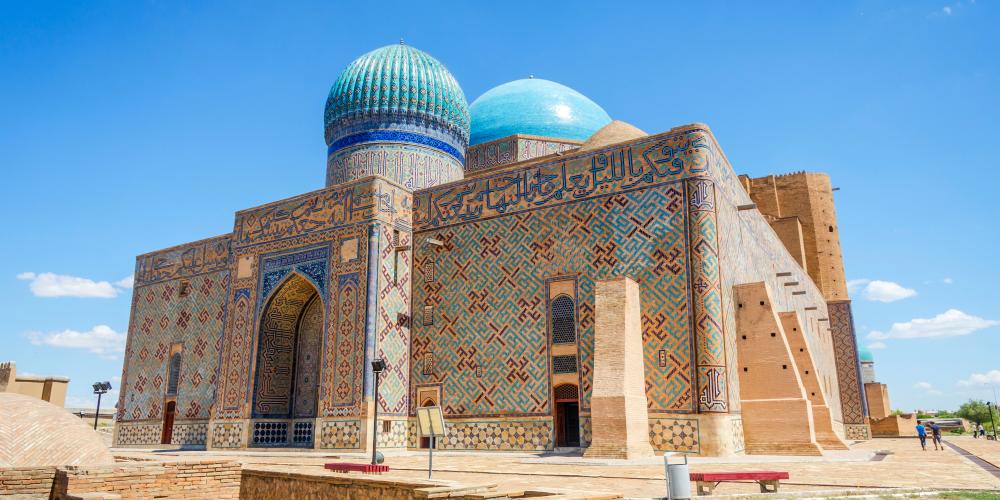
Mausoleum Of Khoja Ahmed Yasawi
Located in Kazakhstan, the Mausoleum of Khoja Ahmed Yasawi is one of the most popular tourist destinations in the country. The mausoleum is a stunning example of Islamic architecture, and it houses the tomb of Khoja Ahmed Yasawi, a famous Turkic poet and Sufi mystic. It is a UNESCO World Heritage Site constructed in the 14th century.
If you’re planning on visiting the Mausoleum of Khoja Ahmed Yasawi, then this travel guide is for you. We will cover everything you need to know about the mausoleum, from its history to its architecture, so that you can make the most out of your visit.
The Mausoleum Of Khoja Ahmed Yasawi
The Mausoleum of Khoja Ahmed Yasawi is a beautiful and imposing building located in the city of Turkistan in Kazakhstan. The mausoleum was built in the 14th century to honor the memory of Khoja Ahmed Yasawi, a famous Islamic scholar and Sufi saint. The mausoleum is considered one of the holiest sites in Islam and draws pilgrims from all over the world.
The exterior of the mausoleum is adorned with intricate brickwork and decorative tiles. The interior is equally impressive, with lavish mosaics and carved marble features. Visitors can explore the different levels of the mausoleum, including the crypt where Khoja Ahmed Yasawi is buried.
The Mausoleum of Khoja Ahmed Yasawi is an important religious site and place of great historical significance. The mausoleum is a testimony to Kazakhstan's rich history and culture and its people.
The Architecture Of The Mausoleum Of Khoja Ahmed Yasawi In Kazakhstan
The Mausoleum Of Khoja Ahmed Yasawi is one of the most impressive and interesting buildings in Kazakhstan. The Mausoleum of Khawaja Ahmed Yasawi's incomplete state, particularly at the entrance gateway and some interior areas, allows for a greater architectural analysis of how the mausoleum was planned and built.
The building has a rectangular shape, with dimensions of 45.8 and 62.7 meters (150.3 and 205.7 feet), and rises to 38.7 meters (127.0 feet). It faces in a southeast-to-northwest direction.
The mausoleum is made of brick, clay, and gypsum and has a beautiful blue dome. Visitors are brought into the Grand Hall, also known as Kazandyk, through the mausoleum's main entrance, located to the southeast. Kazandyk is also called the copper room.
The area is enclosed by the largest brick dome that is currently available in Central Asia, with a diameter of 18.2 meters (59.7 feet). A bronze pot in the middle of the Kazandyk is used for religious rituals.
The Yasawi tomb is positioned towards the northwest end of the structure on the main axis, with the coffin in the middle of the area, which features a double-domed ribbed roof. The height of the outer dome is 28 m (91.9 feet), and the inner dome is 17 meters (55.8 feet).
Hexagonal green glazing tiles with gold designs decorate the exterior of the dome. The outside of the tomb is coated in glazed tiles that form geometric patterns with Qur'anic Kufic and Suls ancient art embellishments.
The inside is ornamented with muqarnas or alabaster stalactites. There are more than 35 rooms in the building, including meeting rooms, a library, a refectory, and a mosque with light blue architectural and floral wall decorations.
When construction was stopped in 1405, two additional minarets were also part of the original plans, but they were never built.
The architecture of the Mausoleum Of Khoja Ahmed Yasawi is unique and worth seeing if you are ever in Kazakhstan.
Location Of The Mausoleum Of Khoja Ahmed Yasawi
The Khawaja Ahmed Yasawi Mausoleum is located in the northeastern section of Turkestan, a contemporary town in southern Kazakhstan that was once named Hazrat-e Turkestan and was formerly a major caravan trade hub known as Khazret first and then Yasi. The building is close to a former citadel that now serves as an archaeological site.
The archaeological area comprises the remains of medieval buildings such as mosques, bathhouses, and various mausoleums. A restored portion of the citadel wall from the 1970s divides the historical region from the developments of the modern town towards the north of the Mausoleum of Khawaja Ahmed Yasawi.
Visiting The Mausoleum Of Khoja Ahmed Yasawi
Heroes are not only found in comic books or on TV. Sometimes, they can be found in history – like Khoja Ahmed Yasawi. Yasawi was a medieval poet and philosopher who played an important role in the spread of Islam in Turkic-speaking countries. His mausoleum is now a major tourist attraction in Kazakhstan.
Yasawi was born in Ispidjab (present-day Sayram) in 1093. He studied at a madrasa (Islamic school) in Bukhara before embarking on a pilgrimage to Mecca. Upon his return, he settled in Yasi (present-day Turkmenistan), where he founded a monastery and began preaching Islam.
His teachings attracted many followers, including Seljuq ruler Sanjar ibn Malik Shah. Yasawi’s influence continued to grow until he died in 1166. Today, his mausoleum is one of Kazakhstan's most popular tourist destinations.
Located in the city of Turkestan, the mausoleum complex includes a mosque, madrasa, museum, and cemetery. Visitors can learn about Yasawi’s life and work, see artifacts from his time, and even visit his tomb.
Conclusion
The Mausoleum of Khoja Ahmed Yasawi is one of Kazakhstan's most popular tourist destinations. This beautiful building is a monument to a religious leader who was highly respected by his community, and it is an excellent example of the region's traditional architecture. If you're planning a trip to Kazakhstan, add the Mausoleum of Khoja Ahmed Yasawi to your itinerary.
00 Comments
No comments yet.
Leave a Comment