

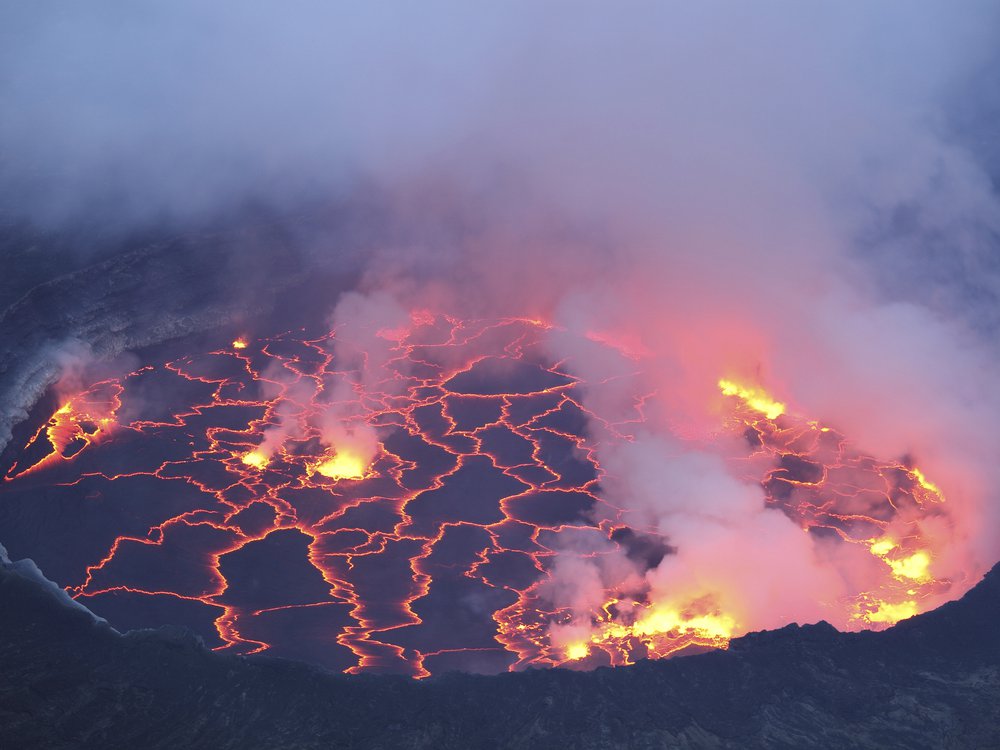
Mount Nyiragongo
Located in the Virunga National Park in the Democratic Republic of the Congo, Mount Nyiragongo is one of the most active volcanoes in the world. Its last major eruption occurred in January 2002, when the lava lake in the crater drained, causing the death of over 100 people.
Despite the dangers, Mount Nyiragongo is a popular tourist destination, with many people eager to see the lava lake up close. It is also a popular destination for scientists studying the volcano and its effects on the local ecosystem. The volcano is popular with tourists, who come to the park to hike to the crater rim and see the lava lake. Several tour operators are offering guided tours to the summit.
This article aims to provide information about Mount Nyiragongo, an active volcano in the Democratic Republic of Congo. We will explore different aspects of this incredible mountain, including its history, geology, climbing experience, and wildlife so that you can make an informed decision about visiting this fantastic place!
Mount Nyiragongo in Democratic Republic of Congo: Introduction
Mount Nyiragongo is an active stratovolcano located in the Virunga National Park, Democratic Republic of Congo (DRC). Its summit stands at an elevation of 11,385 ft (3,470 m) above sea level. It is one of the most active volcanoes in Africa and has erupted many times since 1882. The most recent eruption was in May 2021 and caused significant damage to nearby towns and villages.
Nyiragongo is situated on the western branch of the East African Rift System. This rift system is part of a larger tectonic plate boundary which includes the adjacent Nyamuragira volcano and extends from Ethiopia through Kenya and Tanzania into Mozambique. This volcanic activity is due to the tectonic forces that are pulling apart the Earth’s crust along this region, creating new magma chambers beneath the surface.
The eruptions from Mount Nyiragongo are usually characterized by fountaining lava flows that can travel up to 10 km (6 miles) from its summit, as well as ash fallouts and pyroclastic flows. Due to its frequent eruptions, it has been designated a Decade Volcano by UNESCO's International Association of Volcanology and Chemistry of the Earth's Interior (IAVCEI).
Not only is Mount Nyiragongo one of Africa’s most active volcanoes, but it also offers some spectacular views for tourists visiting Democratic Republic of Congo. From its summit, you can see Lake Kivu in Rwanda as well as Goma town on its eastern flank in DRC. A visit to Mount Nyiragongo provides visitors with a unique opportunity to witness stunning natural beauty while also learning more about volcanic processes first-hand!
Nyiragongo hosts many tour companies that offer all-inclusive trips that take travelers around the volcano’s base, up its slopes, and even inside its crater. Tourists should make sure they bring appropriate clothing to protect themselves from both heat and cold weather conditions during their hike up the volcano’s slopes.
Make sure you don’t miss out on an incredible experience when visiting the Democratic Republic of Congo - check out Mount Nyiragongo!
History and Geology of Mount Nyiragongo in Democratic Republic of Congo
Mount Nyiragongo is a spectacular submarine volcano and is one of the world’s most active volcanoes. It is a popular tourist destination for those looking to explore the unique geology of Africa.
The volcano first erupted in 1882 and has been steadily erupting ever since. It was originally called 'Nyiragongo' by locals, which translates to ‘fire’ or ‘spitting fire’ in the Kikongo language. The mountain is part of the Virunga National Park, a UNESCO World Heritage Site due to its incredible biodiversity and stunning landscapes.
Nyiragongo stands at 3,470 meters above sea level and offers fantastic views of the surrounding area from its summit. It is also home to two crater lakes - Lake Kivu and Lake Nios - which are very popular among visitors who can take boat tours around the lake's shores.
The volcano consists of two distinct cones: an inner cone that rises some 2,500 meters above sea level and an outer cone that reaches only 500 meters high. The lava lake inside the inner crater is one of only four permanent lava lakes in the world, giving visitors a unique opportunity to observe volcanic activity up close.
Geologists have found evidence that Mount Nyiragongo has had several large eruptions over thousands of years, some with devastating consequences for local communities. In 1977, an eruption caused lava flows that reached as far as 20 kilometers away from the summit!
The most recent eruption occurred in 2021, resulting in evacuations in nearby Goma and causing significant damage to infrastructure.
Visitors who visit Mt Nyiragongo can experience its incredible history and geology first-hand, making it a unique destination for nature lovers looking for adventure!
Interesting Facts about Mount Nyiragongo
The volcano of Mount Nyiragongo is well known for its lava lake, which can be seen from the summit. This phenomenon has attracted tourists from all around the world who come to witness its spectacular beauty. Here are some interesting facts about Mount Nyiragongo that you should know before visiting this majestic volcano:
· Mount Nyiragongo's lava lake is one of eight known lava lakes in the world, and it is believed to be the largest active lava lake on Earth.
· The name “Nyiragongo” translates to “Old Fire” in the local Kinyarwanda language and was given by locals who had witnessed its eruptions over time.
· The volcano has erupted more than 35 times since 1882, with its most recent eruption occurring in 2021.
· Due to its height, visitors can enjoy views stretching out across Lake Kivu and parts of Goma city on a clear day when visiting this amazing natural wonder!
· In 1977, researchers discovered pockets of carbon dioxide within caves near Mt Nyiragongo that were capable of suffocating anyone who entered them without special gear - hence why trekking up this volcano requires significant safety precautions!
Despite being considered one of Africa's most dangerous volcanoes due to its proximity to populated areas, Mount Nyiragongo remains a popular tourist destination for those wanting to get up close and personal with this powerful natural force!
Visiting Mount Nyiragongo offers tourists a unique opportunity to witness one of nature's great wonders up close while learning more about volcanology and Earth's geology overall!
With an abundance of fascinating facts surrounding this iconic mountain, there is no doubt that you will have an unforgettable experience here, whether you are an experienced hiker or just searching for an exciting and new activity to do on your next holiday!
Climbing Mount Nyiragongo
The trek to the Nyiragongo volcano is broken into five phases, with a 15-minute respite at each. Starting from the Kibati Ranger Post at an elevation of 1870 meters, hikers ascend to the summit at 3,470 meters, and both distances are about 6.5 kilometers. The time required for climbing varies from 4 and 6 hours, while the time required to descend the volcano is roughly 4 hours.
The first phase of the walk will take visitors through a thick forest at Nyiragongo's base. Hikers are advised to keep an eye out for animals in this area, such as monkeys and bushbuck.
The second half of the forest rises steeply, with open ski paths providing stunning panoramas of the valley below. The final segment takes you past boiling volcanic cracks and across old lava flows. The fourth phase is a traverse through a high montane forest, and the last ascent is a sharp 300 meters to the peak.
The world's largest lava lake, swirling ahead in a mosaic of molten red fire, is Nyiragongo's exciting gift to those who have scaled its slopes, and once at the top, tiredness melts away. However, the most breathtaking sight is saved for last, when the sun sets and Nyiragongo starts to light at night against a sky filled with stars.
How to visit Mount Nyiragongo Safely
To visit Mount Nyiragongo, you must reach Goma, located on Lake Kivu. If you are coming from another country, take a flight to Goma's airport. From there, you can either hire a taxi or a bus to travel to Mount Nyiragongo.
Nyiragongo's eruptions are unpredictable, so it is best to check with local authorities before making your trip.
Conclusion
Mount Nyiragongo is one of the most active volcanoes in the world and is located in the Democratic Republic of the Congo. It is one of the most dangerous volcanoes in the world due to its proximity to densely populated areas.
However, despite this history of destruction, the mountain still lures tourists who come to admire its beauty while respecting its power and danger. If you are planning on visiting Mount Nyiragongo, be sure to consult with a professional guide and take all necessary safety precautions.
00 Comments
No comments yet.
Leave a Comment