

Nairobi National Park
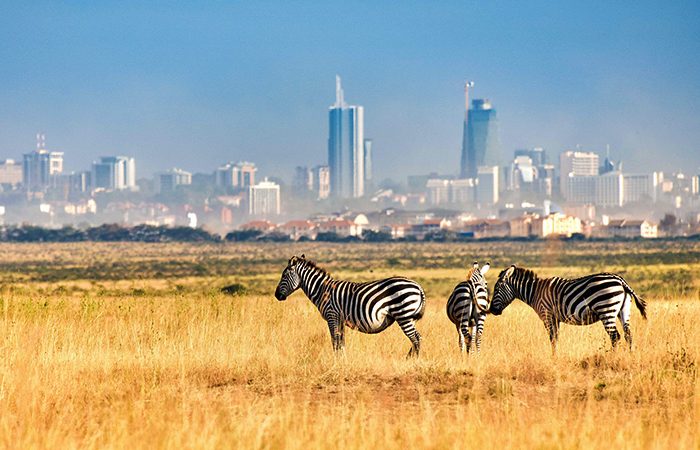
Welcome to Kenya's most pleasant but unique safari experience. The National Park is one of Africa's smallest and most diversified wildlife that may be seen against a backdrop of city skyscrapers and planes landing. It is one of the world's few national parks that border a capital city. Surprisingly, the animals appear completely unfazed.
Nairobi National Park was founded on December 16th, 1946 around 7 kilometers south of Nairobi in Kenya. It is the world's only wildlife park that is so close to the city. The park covers an area of 117 square kilometers and is situated between 1500-1800 meters above sea level. It is enclosed on three sides, with an open southern boundary that permits migrating species to pass between the park and the neighboring Kitengela plains.
Nairobi National Park is being harmed by rising human and livestock populations, changing land use, and animal hunting. Despite its close proximity to the city and limited area, it has a diverse animal population and is one of Kenya's most successful rhinoceros sanctuaries.
To know all about the park to make your trip to Nairobi National Park memorable and more adventurous keep reading the complete article.
Exploring Nairobi National Park in Kenya
During your trip to the Nairobi National Park in Kenya, you will see different bird species and other wildlife in the park. The park also houses an animal orphanage where all the sick animals are taken care of. You will also spot the Ivory statue in the park.
Let’s now have a deep look into what you can see in the Nairobi National Park:
· Bird species
Nairobi National Park is home to around 500 different bird species. The bird species in Nairobi National Park are stunningly beautiful, colorful, and appealing, with prominent species in the park being the Black-headed heron, Blacksmith lapwing, Common moorhen, Long-tailed fiscal, Ostriches, and many more.
Nairobi National Park has a large tract of undisturbed grassland, which is important for bird species such as the restricted-range Jackson's widowbird, which nests in the park during the rainy season. Other grassland bird species in the park include Ostriches, secretary birds, and bustards.
· Nairobi Animal Orphanage
The Nairobi National Park's Animal Orphanage is a care and rehabilitation facility for orphaned, injured, or sick wild animals. It houses a variety of creatures, including lions, hyenas, baboons, monkeys, and any other animal that requires rehabilitation.
The orphanage also serves as an educational and training facility, and it is popular with Kenyan schoolchildren who frequently visit on tours. It is not a must-see for tourists visiting the Nairobi National Park on a day trip, but it may be good for parents with little children because it provides close-up views of the animals.
· Wildlife
Nairobi National Park is home to 80 distinct animal species, 39 lions and 90 rhinos, 40 different amphibians and reptiles, and 500 different tree species. Nairobi National Park is home to the big five: buffalo, leopard, lion, and rhino. The leopard, giraffe, hippopotamus, spotted hyena, blue wildebeest, plain zebra, cheetah, Thomson's gazelle, Grant's gazelle, common eland, impala, hartebeest, waterbuck, common warthog, olive baboon, and black-backed jackal are among the animal species found in the park.
One of the few areas where tourists can be guaranteed of witnessing a black rhinoceros in its natural habitat is Nairobi National Park, which is home to the Kifaru Ark, one of Kenya's most renowned rhinoceros sanctuaries. The Nairobi National Park serves as a significant rhino sanctuary for breeding and park restoration. The park also offers a beautiful wildebeest and zebra migration.
· Statue of Ivory Burning
The Ivory Burning Monument is a historic site where former Kenyan President Daniel Arap Moi burned 12 tons of ivory in 1989. The majority of it was seized before entering the market, kept, and then burned to demonstrate Kenya's commitment to elephant conservation and zero tolerance for ivory trading.
The location is a huge attraction in Nairobi National Park where one can see the ashes that were burnt from the ivory, making your Kenya safari a memorable one.
The Nairobi Safari Walk
The Nairobi Safari Walk is an elevated, curving walkway that traverses the park's three primary ecosystems: wetlands, savanna, and forest, highlighting Kenya's unique natural ecology. The Safari walk has a variety of animal species, including the uncommon bongo, pygmy hippo, and albino zebra, as well as reptiles, birds, and over 100 native tree species.
The first environment you will come across is a marsh, where the water is covered in papyrus and water lilies, as the name says. Keep an eye out for crocodiles and the rare pygmy hippo. In contrast, the wetland habitat gives way to the savanna ecosystem, which is home to a diverse range of creatures such as the albino zebra, white rhino, antelopes, giraffes, hyenas, and many others.
The best way to travel to Nairobi National Park, Kenya
Kenya Wildlife Safari Parks and Reserves are open every day of the week. You can travel to the park by road or by air.
By Road: 10 kilometers south of Nairobi City Center.
By Air: There are two airports in Nairobi, Jomo Kenyatta International Airport and Wilson Airport.
Entry fee for Non-resident: Adult $43 and for Child $22.
Timings:
Terrestrial/Marine Parks: 6.00 am – 6.00 pm
Nairobi Orphanage & Nairobi Safari Walk: 9.00 am – 5.30 pm
Accommodation: You can explore the following locations
· Sala’s Camp
· Mara Toto Camp
· Red Buffalo House Nairobi
· Ashnil Samburu camp
00 Comments
No comments yet.
Leave a Comment