

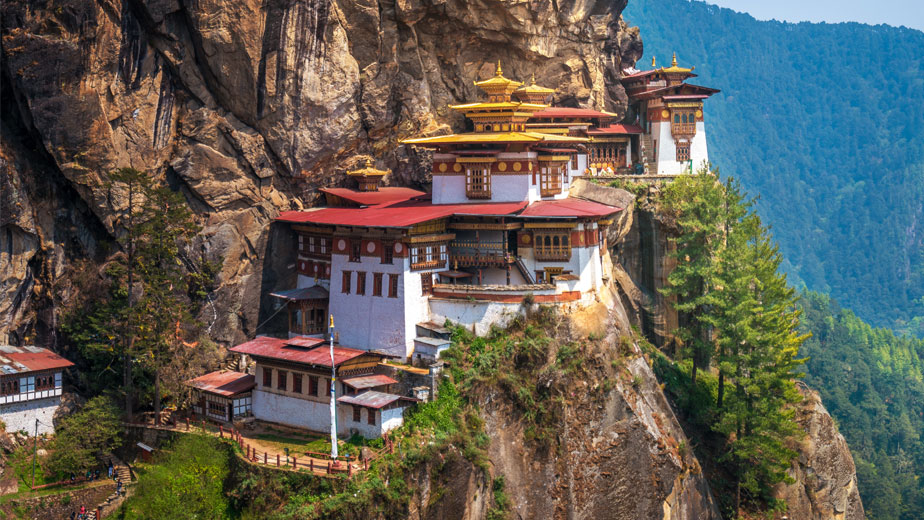
Paro Taktsang
Paro Taktsang, a revered Buddhist site perched on the edge of a cliff more than 10,000 feet above sea level, is regarded as one of Bhutan's most famous and breathtaking tourist attractions. This historic building, also known as the Tiger's Nest Monastery, is rich in myth and history and draws countless tourists every year to behold its magnificence and significance.
Perhaps more fascinating than the location itself is the tale of the Tiger's Nest Monastery. The founder of Tibetan Buddhism, Guru Rinpoche, is said to have flown to the location on the back of a tiger and meditated there for several months. The monastery, which was constructed around the cave in the 17th century, is now a treasured pilgrimage site.
The magnificent mountain scenery, complex architecture, and vibrant spiritual atmosphere of Paro Taktsang are sure to amaze visitors. A trip to this breathtaking location will undoubtedly be an experience of a lifetime, regardless of whether you are an experienced traveler or a curious explorer.
Why Is Paro Taktsang Famous?
Bhutan's Paro Taktsang, usually referred to as the Tiger's Nest Monastery, is a well-known and iconic Buddhist landmark. It is renowned for its breathtaking natural beauty, extensive cultural legacy, and spiritual significance. Guru Rinpoche, also known as Padmasambhava, is supposed to have meditated for several months in the cave where the monastery is located in the eighth century.
The picturesque setting of Paro Taktsang is one of the reasons for its fame. The monastery offers amazing views of the surrounding valley and mountains because it is positioned on the cliff edge more than 10,000 feet above sea level. The trek to the monastery, which is steep and meandering, adds to the sense of adventure and awe.
Paro Taktsang is renowned for its intricate architecture, extensive cultural legacy, and natural beauty. It is regarded as one of Bhutan's most significant and holy religious sites because of the thorough preservation it has received throughout the years. The monastery was constructed in the traditional Bhutanese manner, and its walls are covered with elaborate wood carvings, vibrant murals, and prayer wheels.
The spiritual significance of Paro Taktsang is another factor in its fame. Buddhists from all over the world appreciate the monastery as a place of enlightenment and pilgrimage because it is thought to be a place of enormous spiritual power. Many people visit Paro Taktsang to meditate, pray, and ask the local monks for blessings.
A tour of this famous location is certain to be a once-in-a-lifetime experience and to fill tourists with a profound sense of wonder and amazement.
What Is The History Of Paro Taktsang?
The Tiger's Nest Monastery, also known as Paro Taktsang, has a long history that begins in the eighth century, when Guru Rinpoche, the founder of Tibetan Buddhism, is claimed to have meditated there. Guru Rinpoche is said to have arrived at the location on the back of a tiger and meditated there for several months in a cave. Later, the location was designated as a sacred Buddhist site and turned into a destination for pilgrims.
Tenzin Rabgye, a Bhutanese king, constructed the present monastery in the 17th century all around the cave where Guru Rinpoche is thought to have meditated. The monastery was built in the traditional Bhutanese manner, and its walls are covered with elaborate wood carvings, vibrant murals, and prayer wheels. Since then, it has become one of Bhutan's most recognizable and renowned religious places.
Paro Taktsang has seen many challenges, including natural disasters, fires, and even invasions by foreign troops. Yet, Bhutanese officials have always adequately cleaned and conserved the monument, and it continues to be a significant place of pilgrimage for Buddhists from all over the world.
The number of visitors to the site has been restricted, and sustainable tourism strategies that have a minimal negative impact on the ecosystem are being promoted.
Today, the Paro Taktsang serves as a source of inspiration and wonder for tourists and stands as a tribute to Bhutan's enduring spiritual and cultural traditions.
What Is The Architecture Of Paro Taktsang?
The Tiger's Nest Monastery, or the Paro Taktsang, is a fascinating example of traditional Bhutanese architecture combined with innovative engineering.
The monastery consists of four main temples that are joined by a maze of winding staircases and walkways. The structures have elaborate wood carvings, vivid paintings, and prayer wheels lining the walls. They are made of a combination of wood, stone, and clay.
The inventive way in which the buildings are supported is one of Paro Taktsang's architecture's most striking characteristics. The wooden pillars that make up the monastery's foundation were hammered into the rough ground to provide the building with a solid foundation. Then to expand out from the cliff face without extra support, the buildings were built utilizing a unique cantilever method.
The monastery's magnificent setting is another noteworthy feature of its construction. The monastery offers amazing views of the surrounding valley and mountains as it seems to hang precariously to the cliff face. A steep, meandering trail that takes two to three hours to hike up will lead visitors to the location.
The beautiful wood carvings, vibrant murals, and prayer wheels in the monastery are examples of the talent and imagination of Bhutanese artisans. As a reminder of everlasting spirituality, the carvings and paintings feature scenes from Buddhist mythology and portraits of significant religious people.
What Are The Facts About Paro Taktsang In Bhutan?
Here are some interesting facts about the Paro Taktsang:
· Taktsang Palphug Monastery, also known as Tiger's Nest, is a significant Himalayan Buddhist holy site and temple complex that is situated on a cliffside in Bhutan's upper Paro valley. The monastery complex is commonly referred to as Paro Taktsang.
· The nickname "Tiger's Nest" derives from the myth that Guru Rinpoche arrived at the location riding a tiger.
· The trek to the monastery, perched on the side of a steep slope more than 3,120 meters above sea level, is regarded as one of Bhutan's most challenging and rewarding expeditions.
· The two to three-hour walk to the monastery winds through lovely woodlands and across precarious bridges while providing spectacular views of the valley and mountains beyond.
· The monastery consists of four main temples, joined by a maze of winding staircases and walkways.
· Intricate wood carvings, vivid paintings, and prayer wheels that line the walls of the monastery portray episodes from Buddhist mythology and significant religious personalities.
· With a sacred text housed in a nearby little cell, paintings can be seen on the monastery's walls. This scripture is significant because it was printed using gold dust and the powdered bone of a holy Lama.
· Tourists can also get blessings from the local monks and visit the meditation cave where Guru Rinpoche is said to have meditated.
What Is The Best Time To Visit The Paro Taktsang?
The months of March through May and again from September through mid-November are the best times for visiting Paro Taktsang. Clear skies and ideal weather can be expected during these months. You may also view the gorgeous blossoms, notably Rhododendrons, blooming along the trail leading to Paro Taktsang from March to May.
How To Get To The Paro Taktsang In Bhutan?
The base of the Paro Taktsang Monastery is approximately 12 kilometers from Paro town. To get to Paro Taktsang base, rent a cab. You can get to the trailhead for Taktsang from lower Paro town in around 30 to 40 minutes by car or cab. You should arrive in Paro the day before and begin your walk at around 8 AM.
Conclusion
Paro Taktsang is an amazing place that offers a rare fusion of unmatched natural beauty, extensive cultural legacy, and spiritual importance. One may immerse in Bhutanese culture and discover the nation's intriguing history and religious practices by visiting Paro Taktsang, a breathtaking architectural marvel. The panoramic views of the surrounding valley and mountains are breathtaking. One must visit Paro Taktsang if they are in Bhutan.
00 Comments
No comments yet.
Leave a Comment