

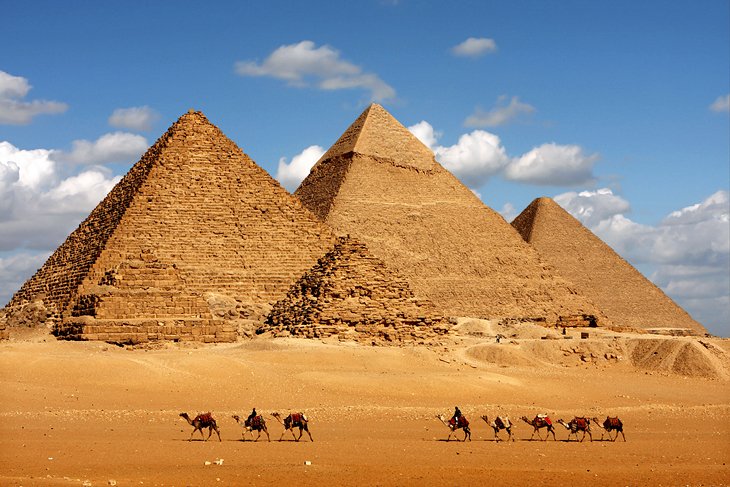
The Pyramids of Giza
The Pyramids of Giza are one of the world's most iconic and well-known structures. They are also one of the most mysterious, with their precise construction and purpose still largely unknown.
The Pyramids of Giza were built around 4,500 years ago during the Old Kingdom period of Ancient Egypt. They were constructed as tombs for Pharaohs and their consorts, and many of them contained vast amounts of treasure. The three main pyramids at Giza were built for Pharaohs Khufu, Khafre, and Menkaure.
The Great Pyramid of Khufu is the largest and most famous of the pyramids. It was built from over 2 million blocks of stone and is over 150 meters tall. The pyramid took around 20 years to construct, and up to 100,000 workers were involved in its construction.
Despite their age, the Pyramids of Giza remain an awe-inspiring sight. They are a testament to the engineering skills of the Ancient Egyptians and a reminder of the grandeur of this lost civilization.
History behind the construction of Pyramids
The Egyptian pyramids are some of the most iconic structures in the world and have been so for millennia. These massive monuments were constructed thousands of years ago, yet they continue to stand today as a testament to the engineering abilities of the ancient Egyptians.
Under the supervision of Pharaoh Khufu, the Pyramid of Giza was constructed in 2560 BCE. This pyramid, known as the Step Pyramid, was built of six stepped tiers made of limestone blocks. Djoser's architect, Imhotep, gave the design for this pyramid of Giza.
The next phase in pyramid construction came during the reign of Pharaoh Sneferu, who commissioned several pyramids, including the Bent Pyramid and the Red Pyramid. These pyramids were constructed of large limestone blocks held together with mortar. The Bent Pyramid gets its name from its angled sides, while the Red Pyramid gets its name from the reddish hue of its limestone blocks.
The Three Pyramids at Giza
All three pyramids were part of a much larger complex that included temples, courtyards, storage rooms, and tombs for family members and high-ranking officials. The entire site was surrounded by a massive wall with entrances guarded by colossal statues known as Sphinxes.
The Great Pyramid of Giza is the largest and oldest of the three pyramids at the site and is also the only surviving member of the Seven Wonders of the Ancient World. It was constructed for Pharaoh Khufu. Earlier, its height measured 146 meters (480 feet) but today stands at 137 meters (449 feet) due to erosion and loss of its original limestone casing.
The second largest pyramid of Giza was constructed for Pharaoh Khafre, believed to be Khufu’s son or grandson. It stands around 10 meters (33 feet) shorter than its neighbor but appears large due to its elevated position on the plateau.
The last Giza pyramid was constructed for Pharaoh Menkaure, who ruled for less than a decade in the mid-25th century BCE. His pyramid is significantly smaller than the other two at just 65 meters (213 feet) tall.
Construction of the Pyramids of Giza
The massive pyramids of Giza were constructed with huge limestone blocks. These limestone blocks were cut and transported from nearby quarries. It took a team of approximately 10,000 workers about 20 years to build just one of these incredible structures.
In addition to their size and age, the Pyramids at Giza are notable for their alignment with the stars. The pyramids are oriented so that their east-west faces align with the cardinal directions. This alignment is thought to have been deliberate and may have had religious or spiritual significance for the ancient Egyptians.
The ancient Egyptians built pyramids as tombs for the pharaohs and their queens. Earlier, by the end of the Middle Kingdom, the pharaohs were buried in pyramids of different shapes and sizes. Queens were buried next to their husbands in pyramids.
Some pyramids were used as tombs for powerful nobles. For people of lower ranks in society, there were smaller pyramids.
The most famous Egypt pyramids are the three Great Pyramids of Giza, but there are many other pyramids in Egypt and Sudan.
The Great Sphinx of Giza
The Great Sphinx of Giza is one of the most iconic images associated with Ancient Egypt. The massive limestone sculpture, which depicts a lion with a human head, has stood guard at the entrance to the Giza Necropolis for over 4,500 years.
Despite its fame, the origins of the Great Sphinx are a mystery. It is believed that by order of the pharaoh Khafre (2558-2532 BCE) during the Fourth Dynasty of Egypt's Old Kingdom period, Sphinx was built, but there is no conclusive evidence to support this claim.
The Great Sphinx was carved from a single piece of limestone and is 73 meters (240 feet) long and 20 meters (66 feet) high. Its imposing size and enigmatic stare have made it one of the most visited tourist attractions in Egypt today, with over 3 million people flocking to see it each year.
How to visit the Pyramids of Giza
The Pyramids of Giza are one of the most popular tourist attractions in Egypt. Millions of people visit the site each year. While visiting the Egypt Pyramids of Giza, one should know a few things:
When to Visit: The best time to visit the Pyramids of Giza is in the morning or evening, when it is not too hot. April to May and October to November are also good times to visit, as the weather is cooler.
How to Get There: The easiest way to get to the Pyramids of Giza is by taxi from Cairo. It is about a 45-minute drive. You can also take a bus or train from Cairo, but it takes longer and is less comfortable.
What to See: The three main pyramids at Giza are the Great Pyramid of Khufu, the Pyramid of Khafre, and the Pyramid of Menkaure. The Great Sphinx is also nearby. You can enter all of these monuments except for the Great Pyramid, which is closed to visitors.
How Much Time You Need: You can easily spend a half day at the Pyramids of Giza, especially if you want to go inside some of the monuments. If you are short on time, you can still see a lot in just an hour or two hours.
Conclusion
The Pyramids of Giza are a wonder to behold. They are a lasting legacy of Ancient Egypt and her people, a testimony to the grandeur and glory of a lost civilization. Even after 4000 years of construction, they continue to fascinate us today.
Today, the Three Pyramids at Giza remain one of Egypt’s most popular tourist attractions. Visitors can explore the inside of the Great Pyramid, which houses three chambers or climb to the top of one of the smaller pyramids for a breathtaking view of Cairo and the surrounding desert landscape.
00 Comments
No comments yet.
Leave a Comment